What’s holding back the Legalization of Battery-Operated Rickshaws? Where is the Barrier to Legalizing Battery-Powered Rickshaws?
If The Government Intends To Promote Battery-Operated Rickshaws And Auto-Rickshaws, Why Is Their Operation Still Legally Prohibited? Is It To Protect The Interests Of Corrupt Practices Within Traffic Enforcement And Political Extortion?

- What’s holding back the Legalization of Battery-Operated Rickshaws?
- Where is the Barrier to Legalizing Battery-Powered Rickshaws?
On February 8, 2024, responding to MP Shamim Osman’s concern about banning battery-operated auto-rickshaws and rickshaws in Parliament, State Minister for Power Nasrul Hamid called these 4 million three-wheelers “Bangla’s Tesla.” The news was prominently covered on the second page of Prothom Alo on February 9.
For the readers’ understanding, Tesla is the most popular electric vehicle in the United States, leading the shift in the Western world towards eliminating fossil fuel-based vehicles.
Nasrul Hamid further mentioned that there is a global revolution aimed at transitioning the transport system to electric as quickly as possible. The efficiency of fuel-driven engines is only 20%, while electric engines boast 80% efficiency.
He added, “We are not obstructing them. Mechanically, there might be faults. But the return on the electricity used is much higher. We are working on a project for them to transition from lead batteries to lithium batteries. We will provide lithium batteries to replace lead batteries.”
If the government truly wants to promote the widespread use of battery-operated rickshaws and auto-rickshaws, why do authorities still treat these vehicles as “legally illegal”?
Nasrul Hamid emphasized the urgent need to shift public transport to electric, highlighting its cost-efficiency and environmental advantages. His remarks indicate that while these vehicles may currently be illegal, the government is adopting a policy to promote their use.
In this context, I ask: If the government intends to promote battery-operated rickshaws and auto-rickshaws, why do they still prohibit their operation by law? Is It To Protect The Interests Of Corrupt Practices Within Traffic Enforcement And Political Extortion?
Battery-operated rickshaws and auto-rickshaws have been present in the country for nearly a decade. In rural and semi-urban areas, they are steadily replacing traditional cycle rickshaws. The use of battery-operated auto-rickshaws has also grown over the years as they are more cost-effective than CNG auto-rickshaws for short-distance travel in Bangladesh. In many places, traditional cycle rickshaws are becoming a rarity.
These vehicles have become the primary mode of transport in many areas, a change that I consider a welcome modernization and environmentally friendly alternative. Some critics argue that these vehicles are mechanically faulty and hazardous. However, areas with widespread use of these vehicles haven’t seen a significant rise in accident rates. While mechanical flaws remain a valid concern, battery-operated auto-rickshaws haven’t caused major safety issues so far.
While sudden braking may pose a risk, such incidents are not frequent enough to deter users. If it were a severe problem, users would have already shown reluctance in using them. However, for understandable reasons, authorities should not legalize their use on highways—just like cycle rickshaws.
I see no reason to discourage this employment opportunity for the marginalized population that reduces physical strain. I urge the government to draft clear legislation that grants legal status for battery-operated rickshaws and auto-rickshaws on rural roads and smaller city streets, while maintaining a ban on their use on national highways and major city roads.
Shamim Osman pointed out the illegal use of electricity for charging these rickshaws, which is a valid concern. Using 700–800 MW of power illegally is not a trivial matter. In response, Nasrul Hamid outlined steps to encourage the legal use of electricity. I urge him to prioritize and expedite these government projects, especially transitioning from lead to lithium batteries.
China has been successful in competing with developed nations in expanding solar power use, but Bangladesh has yet to achieve significant success in renewable energy. In his February 8, 2024, statement in Parliament, Nasrul Hamid noted that the national grid includes only 459 MW of solar power—just 2% of the total. By November 2023, all renewable sources combined generated only 1,195 MW of electricity. This shortfall is unacceptable. The country’s reliance on mega projects for coal-based power has become an unsustainable burden, and dependence on imported LNG has already placed the power sector in peril.
The Sustainable and Renewable Energy Development Authority has recommended a target of 30,000 MW of solar power, including 12,000 MW from rooftop solar panels.
The government can achieve 12,000 MW from rooftop solar by implementing subsidies for solar panels and batteries, reducing tariffs on solar equipment, and introducing an effective ‘Net Metering’ system.
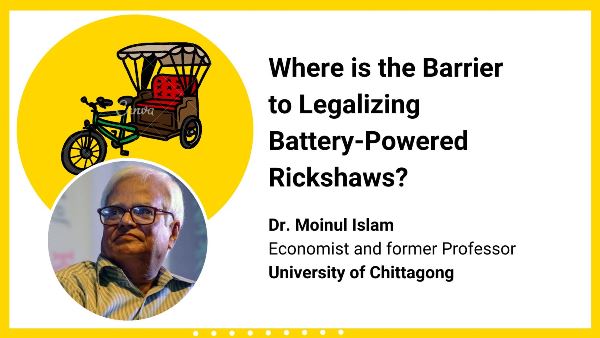
Dr. Moinul Islam is an economist and former professor of economics at Chittagong University. Based on Prothom Alo; Translated by Consumer News Today.